
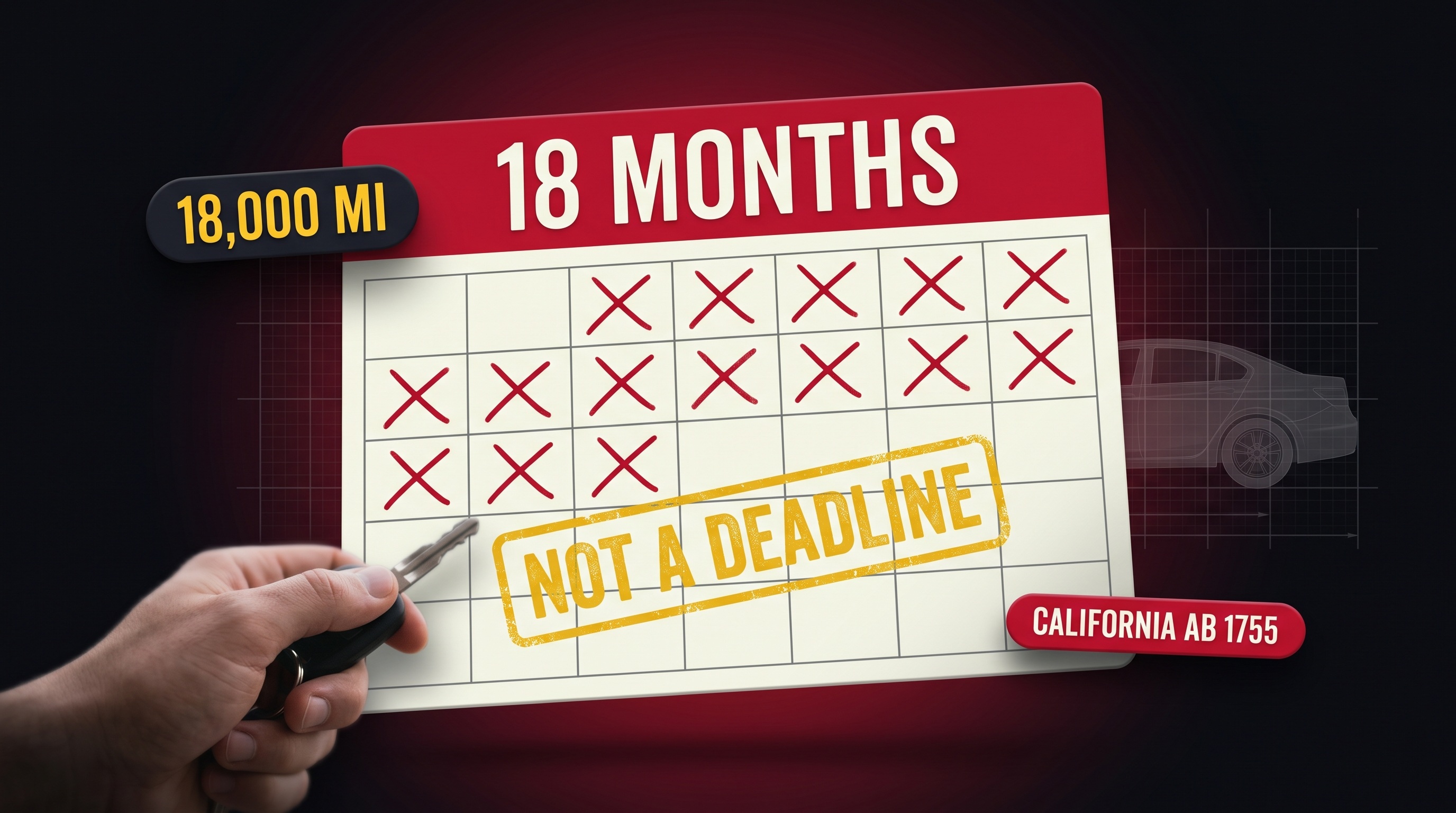
If you're reading this, there's a good chance you've already heard some version of these words from a dealership service writer or a manufacturer's customer service line: "You're outside lemon law now." "It had to happen in the first 18 months or 18,000 miles." "The warranty period is over — there's nothing we can do."
Take a breath. Those statements are often overstated, incomplete, or simply wrong.
The 18-month/18,000-mile figure is not a brick wall. It is not the date your rights expire. It is a presumption window — a procedural shortcut written into California's lemon law to make early cases easier to prove. Once you understand the difference between a presumption and a deadline, the picture changes entirely.
At Power Legal Group, our head attorney Bobby Yaghoubian has spent years dismantling exactly this kind of misinformation on behalf of California drivers. Below, he walks through what the rule actually means, why so many consumers are misled about it, and what you can still do if your defective vehicle has pushed past that early window.
What the 18-Month/18,000-Mile Rule Really Says
The rule comes from California Civil Code § 1793.22(b), part of the Song-Beverly Consumer Warranty Act. As Bobby Yaghoubian explains, the statute creates a legal presumption that a vehicle is a lemon when a qualifying defect surfaces within the first 18 months of delivery or 18,000 miles — whichever comes first — and the manufacturer has had a reasonable number of repair attempts (or the vehicle has spent enough time out of service).
That presumption exists for four practical reasons:
- It gives consumers a clearly defined early window for the strongest version of the claim.
- It encourages drivers to bring vehicles in for prompt repair attempts.
- It makes proof easier when a defect appears early and keeps recurring.
- It blocks manufacturers from later arguing that a long pattern of failures was unrelated to the original warranty defect.
In other words, the rule was designed to help consumers — not to silently strip them of rights the moment the odometer rolls past 18,000 miles.
The 18-month/18,000-mile rule is a shortcut to proving a case, not the finish line for having one. When a dealer tells someone their rights ended at 18,000 miles, that's almost never the full legal picture.
Presumption vs. Deadline: The Critical Difference
Here's where dealerships and manufacturer hotlines tend to blur the lines. There is a meaningful legal distinction between:
- The presumption window (18 months / 18,000 miles): a window where the law presumes certain conditions add up to a lemon.
- The actual claim window: governed by separate statutes of limitations and the duration of express and implied warranties — which can extend significantly longer.
Missing the presumption window simply means you no longer get the procedural shortcut. It does not mean your warranty claim, your fraud claim, your federal warranty claim, or your implied warranty claim has disappeared.
This is exactly the misunderstanding the team at Power Lemon Law sees most often: a frustrated consumer who was told they were "too late" — when in reality, their defect history is well-documented, the manufacturer had multiple chances to repair, and a viable case is sitting right there in the repair orders.
What Changed on January 1, 2025: AB 1755
California's lemon law landscape shifted in 2025 with Assembly Bill 1755, later refined by SB 26. According to the California Department of Consumer Affairs, manufacturers now generally have three options: opt into the new statutory procedures, continue under the existing California lemon law framework, or pursue certification through the Arbitration Certification Program.
What that means in plain English:
| Your Situation | Likely Practical Impact |
|---|---|
| Bought/leased before Jan. 1, 2025 | Most cases will still be evaluated under the traditional Song-Beverly framework. Your existing rights aren't automatically erased. |
| Bought/leased on or after Jan. 1, 2025 | The new AB 1755 procedures may apply, depending on whether the manufacturer opted in. |
| Manufacturer didn't opt in | You generally remain protected under traditional California lemon law. |
The critical takeaway: AB 1755 is manufacturer-election driven. Whether the new procedures apply depends on which path the specific manufacturer chose for your specific claim. This is exactly the kind of analysis you should not be doing alone — and it's exactly what the attorneys at Power Lemon Law evaluate at no cost during an initial review.
Laws That Still Protect You After 18 Months / 18,000 Miles
This is where most consumers — and frankly, most dealership representatives — stop reading the statute book. Bobby Yaghoubian walks clients through a full menu of legal theories that can remain alive long after the presumption window closes.
1. Song-Beverly Still Applies
You can still bring a Song-Beverly claim after 18 months/18,000 miles if you can show:
- The defect was covered by a manufacturer warranty,
- It substantially impaired the vehicle's use, value, or safety,
- The manufacturer or its repair network had a reasonable number of repair attempts, and
- The defect was never adequately fixed.
The statutory presumption is a tool — not the only path.
2. The Magnuson-Moss Warranty Act (Federal Law)
Under 15 U.S.C. §§ 2301–2312, federal law provides an independent remedy when a written warranty hasn't been honored. Different mechanics, different leverage — but a real claim.
3. The Consumers Legal Remedies Act (CLRA)
Cal. Civ. Code § 1770 can apply when there has been deception or unfair conduct in the transaction — for example, misrepresentations about the vehicle's condition, prior repairs, or certification status.
4. Implied Warranties Under California Law
Under Cal. Com. Code §§ 2313 and 2314, and Song-Beverly's implied warranty provisions, you may still have viable claims tied to merchantability and fitness for ordinary use.
5. Fraud, Concealment, and Misrepresentation
If the dealership or manufacturer knew about a defect and concealed it — or made false statements about repair history or vehicle condition — common-law claims for fraud and concealment may apply.
Past 18 months or 18,000 miles often means the case is harder — not hopeless. The defect history usually tells a different story than the dealership wants you to hear.
Not sure if your case is still alive?
Our attorneys read the repair orders, evaluate every available legal theory, and tell you straight whether you have a viable claim. Free, no obligation, no fees unless we win.
Start Your Free Case ReviewWhich Defects Tend to Stay Viable the Longest?
In Power Legal Group's experience, certain defects remain particularly strong well beyond the early window because they are intermittent, hard to duplicate on demand, or safety-related.
Transmission Defects
Slipping, jerking, harsh shifting, hesitation, gear hunting, limp mode.
Engine Defects
Stalling, misfires, rough idle, excessive oil consumption, loss of power.
Electrical Defects
Infotainment failures, parasitic battery drain, sensor faults, charging issues.
Advanced Safety Systems
Airbags, ABS, braking assist, lane-keeping, collision avoidance, steering assist.
Recurring Warning Lights
Check engine, hybrid system warnings, propulsion warnings, EV system faults.
Intermittent & "Unable to Duplicate"
Defects the dealer can't reproduce — but the diagnostic codes remember.
These defects often leave a robust paper trail in repair orders and diagnostic codes — exactly the kind of evidence that strengthens a late-stage lemon law claim.
Common Mistakes Drivers Make Before Calling a Lawyer
Most of the damage to a potential case happens between noticing a problem and calling an attorney. Bobby Yaghoubian points to the same patterns repeatedly:
- Stopping repair visits too soon after being told "it's normal."
- Relying only on independent shops when warranty repair history at the dealership is usually critical.
- Failing to document symptoms — leaving the story locked in memory instead of in writing.
- Not preserving repair orders that contain language manufacturers later try to walk back.
- Accepting vague explanations like "could not duplicate," "within spec," or "normal characteristic" without follow-up.
- Skipping follow-up visits after the problem recurs, which weakens the "reasonable number of attempts" argument.
- Continuing to drive a worsening safety issue without documenting it through the dealer.
The good news: if you still have any of the paperwork, much of the damage is recoverable.
What to Gather Before Your Free Case Review
Bring whatever you have. You do not need a perfect file. You just need a starting point.
- Purchase or lease agreement
- Warranty booklet and any service contracts
- All repair orders, invoices, and estimates
- Tow receipts and rental car receipts
- Emails, texts, and voicemails with the dealer or manufacturer
- Photos and videos of the defect (including dashboard warning lights)
- Recall notices or Technical Service Bulletin (TSB) references
- Odometer and registration records
- The first date you noticed the problem
- Exactly what the vehicle did and what warning lights appeared
- Whether the defect affected steering, braking, acceleration, electrical systems, or caused stalling
- Every visit where you raised the same complaint
- How long the dealer kept the vehicle each time
Does a "Goodwill Repair" Hurt My Case?
Short answer: usually not — and sometimes it helps.
A complimentary or "goodwill" repair is not the same as a legal waiver. If the defect kept coming back, that goodwill repair can actually become part of the repair history supporting your lemon law claim — and it can demonstrate the manufacturer had notice of the problem.
What matters is:
- Whether the goodwill repair appears on a repair order
- Whether you signed any release, waiver, or settlement
- Whether the issue actually got fixed or simply got masked
If you're unsure what you signed, bring it. We'll tell you what it means.
Stop Guessing. Get a Real Answer.
The dealership has a script. The manufacturer hotline has a script. Both are designed to make you walk away.
You deserve an actual legal analysis — from attorneys whose entire focus is fighting for California consumers stuck with defective vehicles. At Power Lemon Law, every case review is free. There's no obligation, and we don't get paid unless we win. If you've been told you missed the deadline, let us be the second opinion that actually reads the paperwork.
Led by head attorney Bobby Yaghoubian, Power Legal Group has built its reputation on advocating fiercely for California drivers — especially the ones the manufacturers have written off.
You may still have a case. Let's find out together.
Led by head attorney Bobby Yaghoubian, Power Legal Group is a California consumer protection firm fighting for drivers stuck with defective vehicles. A division of Power Legal Group, PC.