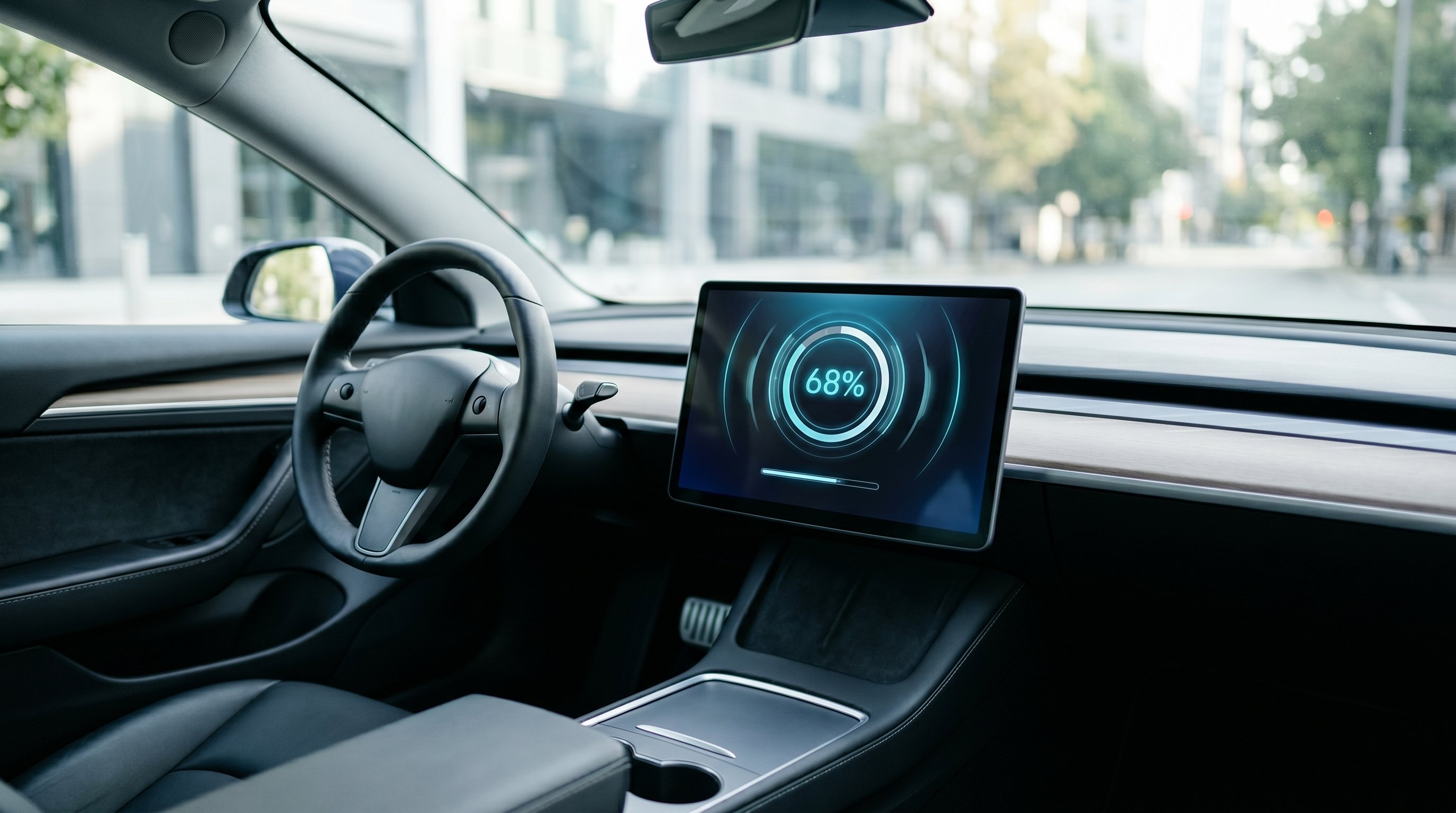
Modern electric vehicles run on software. When something goes wrong with the battery, the charging system, the driver-assistance features, or the screen that controls almost everything, the manufacturer often pushes a fix straight to the car overnight. No appointment. No loaner. No service writer. The problem is supposed to be gone by morning.
That is genuinely useful technology. It also runs straight into a law written for a very different era. California's lemon law was built around a physical process: you notice a defect, you take the car to the dealer, a technician works on it, and you walk out with a repair order. Over-the-air updates skip almost every step of that. So when an update is meant to cure a defect, the natural question for any owner is simple. Does that update count as a repair attempt?
The honest answer is that it depends, and the law has not fully caught up. Below is what California law actually says, where the gray area is, and the practical steps that protect your rights while the courts sort it out. For a broader overview of how these claims work, see our guide to California lemon law.
The Short Answer
We are not aware of a published California appellate decision that squarely decides whether an over-the-air update, on its own, counts as a repair attempt. It is an unsettled area, and outcomes today turn on the facts of each case.
What helps your position is a clear link between the update and a specific defect. If you complained about a problem, the manufacturer pushed an update aimed at that problem, and the issue continued, you have a strong argument that the manufacturer took a shot at fixing the car and missed. That is exactly what the lemon law cares about. A routine update that simply adds a feature or refreshes the maps is a much weaker basis for a claim.
What Counts as a "Repair Attempt" in California
California's lemon law lives in the Song-Beverly Consumer Warranty Act, starting at California Civil Code section 1790. The core promise is in section 1793.2(d): if the manufacturer cannot fix a vehicle to match its warranty after a reasonable number of attempts, it has to buy the car back or replace it.
A companion provision, the Tanner Consumer Protection Act at section 1793.22, gives drivers a presumption that makes early cases easier to prove. In general terms, that presumption can apply when, within the first 18 months or 18,000 miles, any of the following happens:
- Two attempts at a defect that is likely to cause death or serious injury.
- Four attempts at the same defect that does not rise to that level.
- More than 30 cumulative days out of service for warranty repairs.
Notice how much rides on the word "attempts." And here is the part that surprises people: a repair attempt can count even if the technician does no actual work. Under California's official jury instructions (CACI No. 3202), each time the vehicle is given to the dealer for repair counts as an opportunity to fix it, even if no repair work is done. A visit where the dealer says "could not duplicate" and hands the keys back still counts. So does plugging in a laptop, reflashing a module, and clearing a code without touching a single bolt.
That last point is the heart of the software question. If a technician reflashing your car's software inside the service bay counts as a repair attempt, why would the exact same code, sent wirelessly instead of through a cable, count for less?
A repair attempt has never required a wrench. If the fix is the same code either way, the method of delivery should not quietly erase a consumer's rights.
Why Over-the-Air Updates Blur the Line
The tension comes from another part of the same statute. Section 1793.2(c) says the buyer has to deliver the vehicle to the manufacturer's repair facility so it can be fixed. California courts have long emphasized that the manufacturer must be given a genuine opportunity to repair the vehicle, which has traditionally meant the car physically arriving at the shop.
An over-the-air update flips that picture. The car never leaves the driveway. Nobody hands over the keys. There is no in-person presentation at all. So the manufacturer can argue that without delivery, the statute's repair process never started, and the attempt counter never moved.
Consumers push back with the practical reality. When an automaker sends targeted code to a specific car to cure a known defect, it is clearly trying to fix the vehicle. The intent and the result are the same as a bay visit. Treating that as nothing simply because it traveled over a cell network would let manufacturers rack up unlimited invisible repair tries that never appear on any tally.
The Arguments on Each Side
Because the question is open, both sides have a real position. Here is the short version of each.
| The Consumer Argument | The Manufacturer Argument |
|---|---|
| A targeted update is an attempt to cure a known defect, so it should count. | The statute requires delivery of the vehicle, and an update involves no delivery. |
| The same software fix counts when done at the dealer, so it should count over the air. | Many updates are routine and fleet-wide, not a response to one car's complaint. |
| The lemon law is meant to protect buyers and should keep pace with technology. | Counting every background update would turn normal maintenance into liability. |
In practice, the dividing line tends to be whether the update was aimed at a specific defect you reported, or registered as the official remedy for a recall, rather than a general improvement pushed to every car on the road. Federal regulators now accept over-the-air updates as a valid way to carry out safety recalls. A recall being handled by software is a separate legal question from whether it counts as a repair attempt under the lemon law, so it is persuasive context rather than an automatic rule. Still, it makes for an awkward position when a manufacturer calls the same update a real fix in one breath and a non-event in the next.
The Real Problem: No Repair Order, No Paper Trail
Even when the law eventually favors you, there is a more immediate obstacle. Lemon law cases are built on paperwork. A traditional dealer visit creates a repair order that records your complaint in your words, the date, the mileage, the diagnosis, and the work performed. That document is the backbone of almost every claim.
An over-the-air update creates none of that. There is no intake, no service writer, no odometer reading, and no invoice. You usually get a brief notification on the screen or the phone app, and then it disappears. That gap causes three concrete problems:
- Proving the attempt happened. Without a record, it is harder to show an update on a given date was aimed at your specific defect rather than a routine refresh.
- Proving the mileage. California reduces a buyback by a usage amount tied to the mileage at the first repair attempt for the defect. No recorded mileage means a dispute over money.
- Proving days out of service. If a bad update leaves the car unusable in your driveway, the manufacturer may argue it was never officially out of service because it never entered a repair facility.
The fix for all three is the same: you have to create the record the manufacturer no longer creates for you.
Not sure if your updates added up to a case?
Our attorneys read the history, line up the software timeline against your complaints, and tell you straight whether you have a viable claim. Free, no obligation, no fees unless we win.
Start Your Free Case ReviewHow AB 1755 Raises the Stakes
California's lemon law process changed in 2025 with Assembly Bill 1755, later refined by SB 26. The reforms speed up how claims move, with earlier deadlines, a pre-suit notice step, and faster timelines for manufacturers that opt into the new procedures. Whether the new rules apply to your claim depends on the manufacturer and the path it chose. We cover exactly how that works in our guide to the 2025 AB 1755 and SB 26 changes.
For EV owners, the practical effect is that the clock moves faster than it used to. A compressed timeline rewards drivers who already have their evidence organized and punishes those who wait to gather it. When much of your repair history exists only as software notifications, getting that record in order early matters more than ever. For more on these deadlines, read our breakdown of the 18-month and 18,000-mile rule.
EV Defects That Tend to Get the Software Treatment
Certain electric-vehicle problems show up again and again, and manufacturers frequently address them with code rather than parts. These are worth watching closely because they often recur after an update.
Battery & Range
Sudden range loss, parasitic drain while parked, inability to hold a charge, false thermal warnings.
Charging Faults
Failed handshakes with DC fast chargers, interrupted sessions, and inconsistent charge speeds.
Driver Assistance
Phantom braking, lane-keeping errors, and unpredictable behavior from cameras and sensors.
Infotainment
Random reboots, frozen screens, and blackouts that take the backup camera and climate controls with them.
Power Delivery
Sudden loss of drive power, limp mode, and propulsion warnings tied to inverter or motor control.
Recurring Warnings
EV system faults and warning lights that clear after an update, then return weeks later.
When one of these keeps coming back after each update, that pattern is often the strongest part of a claim. The defect history tells the story even when the dealer's file is thin.
What EV Owners Should Do Right Now
You do not need to be a lawyer to protect your case. You just need to act like your own service writer and keep a clean record. These habits make the difference between a claim that moves and one that stalls.
- The date and time of each update
- The mileage before and after
- The software version before and after
- The symptom it was meant to address, in your own words
- Whether the problem actually went away, and for how long
- Take timestamped photos or video of warning lights, black screens, and error messages as they happen
- Save the update notifications from the screen or the app
- When a defect returns, bring the car to an authorized dealer so a written repair order is created
- Make sure the repair order quotes your exact complaint, not a vague summary
- Keep purchase, lease, and warranty documents in one place
The single most valuable move is the third one in that second list. If an update was supposed to fix something and the problem comes back, take the vehicle in. A physical visit creates the repair order that removes any argument about whether a real repair attempt happened. It turns an invisible software event into hard evidence.
Frequently Asked Questions
Do over-the-air updates count as repair attempts in California?
We are not aware of a published California appellate decision settling it yet, so it remains an open question. Your position is strongest when an update was aimed at a specific defect you complained about, or was the official remedy for a recall, and the problem continued afterward.
How many repair attempts do I need?
As a general guide, the Tanner presumption points to two attempts for a defect likely to cause death or serious injury, four attempts for the same defect otherwise, or more than 30 cumulative days out of service, within the first 18 months or 18,000 miles. You can still have a claim outside that window.
There is no paperwork for my update. Is my case dead?
No. Your own log, saved notifications, photos, and any later dealer visit can rebuild the record. The earlier you start documenting, the stronger your position.
The update did not fix the problem. Does that help me?
It can. An update meant to cure a defect that then failed is evidence the manufacturer had a chance to fix the car and the defect persisted, which is the center of a lemon law claim.
Talk to a California Lemon Law Attorney
The law around software updates is still taking shape, but your rights as an EV owner are real today. If your electric vehicle keeps having the same problem after update on update, you may have a case even if you never set foot in a service department.
At Power Lemon Law, every case review is free. There is no obligation, and we do not get paid unless we win. Bring whatever you have, even if it is only a few screenshots and a timeline, and we will tell you honestly whether your updates add up to a claim. You can contact us here or call 877-323-LEMON.
If your EV keeps breaking the same way, let us take a look.
Led by head attorney Bobby Yaghoubian, Power Legal Group is a California consumer protection firm fighting for drivers stuck with defective vehicles. A division of Power Legal Group, PC.